
What software helps manage an ecovillage or permaculture project without losing its horizontality and community essence?
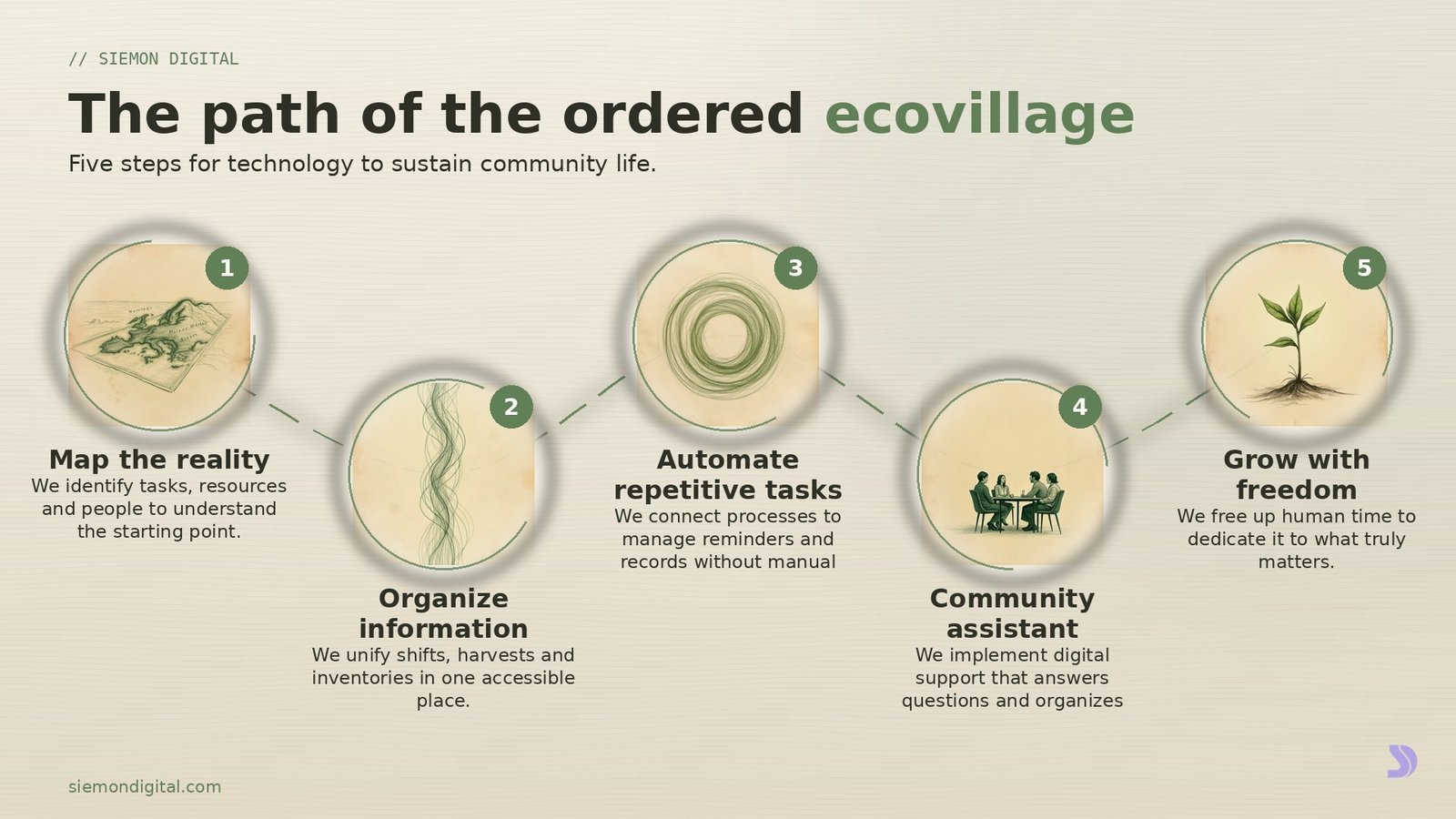
An ecovillage is an expanding universe with dozens of hands shaping it at once. You have assemblies, work shifts, harvest tracking, incoming volunteers, donations to trace, and shared decision-making. When all of this lives across WhatsApp groups, physical notebooks, and scattered spreadsheets, details get lost, and good intentions clash with disorganization.
The irony is that the very spirit that makes an ecovillage special (flat hierarchies, trust, collective work) is often what makes organization feel hard. Nobody wants to impose a rigid system on a project built on collaboration. But here lies the real opportunity: there is a way to organize operations that respects community rhythm and frees up time for what actually matters: farming, learning, and living together. That is the path we take at Siemon Digital, always starting from the specific problem each community faces.
What a Well-Thought-Out Ecovillage Software Actually Solves
Software for an ecovillage isn't meant to replace assemblies or collective decision-making. Its job is to support backend operations so human energy stays focused on what only humans can do: talking, deciding together, caring for the land, and building community.
Some common bottlenecks we see in permaculture projects and intentional communities:
- Manual tracking of work shifts and community tasks that creates confusion over who did what
- Volunteer and visitor management: requests, dates, agreements, and follow-ups scattered across emails and chat apps
- Harvest logs, seed inventories, and shared resource tracking without a central dashboard
- Community agreements and protocols getting lost across separate files and personal memories
- Tracking financial or in-kind contributions from each member or family unit
Every single one of these friction points can be solved with a custom system, without forcing the community to adapt to generic software built for traditional corporations.
Process Automation That Frees Up Time for the Land
Automation isn't a corporate luxury. It is a practical tool for any collective that wants to spend more hours planting and fewer hours filling out repetitive forms. Real-world examples of what can be automated:
- When someone applies to volunteer through a simple form, their info automatically lands on a clean dashboard, and an automated response sends them the next steps
- Community work shifts are assigned and remembered automatically, stopping one single person from carrying all the coordination weight week after week
- Harvest or maintenance reports sit in one central location, cutting out the copy-pasting between notebooks and chat groups
- Dues or financial contributions are logged automatically, sending gentle reminders only when needed
This doesn't reduce flat organization, it reinforces it: information remains visible to everyone instead of being trapped in one person's head.
Applied AI at the Service of the Community, Not as a Trend
Artificial intelligence can be a real multiplier when applied thoughtfully to actual community needs. Here are concrete use cases we have built for projects with ecovillage dynamics:
- Automatic sorting of volunteer applications based on skills, availability, and project priorities
- Internal AI assistants that answer common questions from new members or visitors (schedules, community guidelines, what to bring) without overwhelming coordinators
- Pattern analysis across harvests or resource consumption to forecast planting needs or supply purchases
- Automatic assembly summaries so members who couldn't attend can catch up on key decisions in minutes
AI here doesn't replace the community's human voice; it amplifies its capacity to organize without getting bogged down in repetitive tasks.
Custom Software and Systems Designed for Your Community's Unique Path
Every ecovillage has its own rhythm for making decisions, dividing tasks, and connecting with its environment. That is why off-the-shelf CRMs or generic dashboards rarely fit. Building a dedicated system lets you create:
- A central hub showing at a glance who is on shift, which crops are in progress, and pending volunteer requests
- A simple portal for new members or visitors to register, sign agreements, and access necessary info before arrival
- Seamless integrations between the tools your community already uses (calendars, forms, spreadsheets) so you don't have to migrate everything overnight
This kind of Command Center, built for the scale and spirit of your project, follows the same core approach we apply at Siemon Digital for businesses of all sizes: start with what already exists and build on top of it.
Document and Data Management That Preserves Collective Memory
Ecovillages accumulate invaluable wisdom over time: living agreements, water management protocols, natural building logs, assembly notes. When that knowledge stays scattered, it fades over time or leaves when members move on.
A structured document management system helps you:
- Centralize agreements and protocols in an accessible repository with instant search
- Keep a historical record of decisions so new members understand context without having to ask every question from scratch
- Protect sensitive data (financial contributions, contact details) with appropriate access permissions
This turns community memory into a living asset rather than loose files that only one person knows how to find.
Every Ecovillage Is a Unique Universe, and Its System Should Be Too
There is no single template that works for every community, which is why starting from your real operational challenges works far better than chasing tech trends. An ecovillage focused on regenerative agriculture needs something completely different from an environmental education project or a network of families sharing land with separate finances. Your path is unique, and the system supporting it should reflect that.
If your community, permaculture project, or collective initiative has a process taking up more energy than it should, there is a way to streamline it while keeping your core values intact. Book a free diagnostic call at https://siemondigital.com/book-call/ and let's discuss the specific bottleneck you're experiencing. Sometimes all it takes is seeing where the friction lives to transform it into newfound freedom for the entire project.
---
Leading an ecovillage or permaculture project? See what a custom digital ecosystem built for your community could look like at siemondigital.com/l/eco.
Frequently asked questions
What organizational challenges do ecovillages or permaculture projects typically face?
When a community relies entirely on WhatsApp chats, paper notebooks, and scattered spreadsheets to keep records, it is easy to lose track of who worked which shift. Managing volunteers and visitors ends up split across emails and messages without a single source of truth. There is also rarely a centralized dashboard to track harvests or seed inventory, and community agreements and protocols get lost across different files and individual memory.
Does ecovillage software replace decisions made by the community assembly?
No. Ecovillage software is not designed to replace the assembly or take away the community's collective decision-making. Instead, it handles day-to-day operations so members can focus their energy on what truly matters to them: having discussions, making decisions together, and caring for the land and community life. Far from reducing horizontal governance, automation actually strengthens it by keeping information visible to everyone rather than relying on what a single person remembers.
What can be automated when managing volunteers in an intentional community?
Volunteer applications submitted through a form can be automatically organized on a dashboard, triggering an instant reply that explains the next steps without anyone having to write an email manually. An AI assistant can also filter and sort these applications based on skills, availability, and the project's current needs, as well as answer common questions for newcomers (such as schedules or community guidelines) without overwhelming the coordinator.